Spreading of the Arabic Emphatic “Dhad” with Short and Long Vowels
An ultrasound and acoustic study of how consonant position and vowel length shape emphasis spread in Egyptian Arabic.
Research question
Arabic emphatics combine a primary oral constriction with a secondary posterior articulation that can influence surrounding segments. The paper asks how far the emphatic quality of /ḍ/ spreads, whether its direction changes when /ḍ/ is initial, medial, or final, and whether long vowels provide a stronger environment for visible spreading than short vowels.
Study design
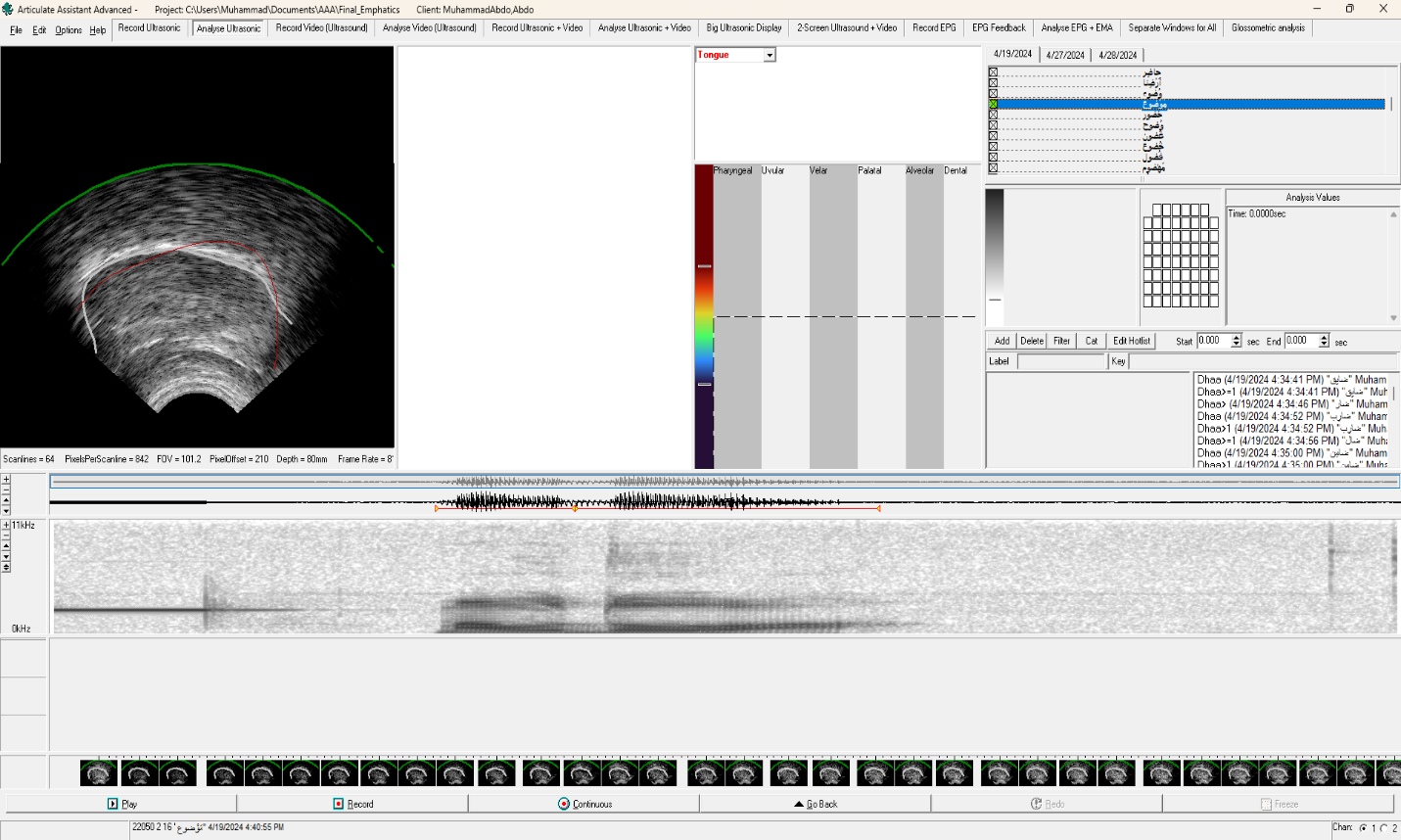
Synchronized ultrasound and acoustic recordings were examined in Articulate Assistant Advanced. Tongue contours and spectrographic information were used together to compare the articulatory footprint of /ḍ/ across positions and vowel environments.
What the analysis found
- Both consonant position and vowel length influenced the observed reach of emphasis.
- Medial /ḍ/ showed the clearest rightward spread; leftward effects were less frequent.
- Initial and final positions also showed spreading, especially in several long-vowel environments.
- Long vowels provided a larger temporal window in which the secondary articulation could be observed.
Visualization and commentary
Limits and next steps
The study uses one Egyptian Arabic speaker, so it cannot separate stable phonological tendencies from individual articulation. The next study should add multiple speakers and Arabic varieties, use quantitative tongue-contour comparison, balance segmental contexts, and connect articulatory measures with formant trajectories. The current project establishes a workable ultrasound protocol and a set of directional hypotheses for that larger experiment.