Research

Research Projects

Studying how AI systems represent language, generalize across settings, and connect predictions to evidence — from mechanistic analysis to multilingual evaluation and knowledge grounding.

Active Research

Mechanistic Interpretability for Speech Models

Active

Applying mechanistic interpretability to speech transformers to identify how models encode linguistic nativeness. Probing internal representations for phonological and morphological structure, using Arabic speech as a focused testbed. Presented at NLP @ Michigan Day 2026.

Mechanistic Interp. Speech Transformers Model Internals

Multilingual NLI & Label Drift

Active

A large collaborative project (10 co-authors) examining how NLI label distributions drift when inference data undergoes machine translation across languages. Tests the reliability of multilingual benchmarks and cross-lingual transfer. Presented at MSLD 2026 and ASAL39.

NLI Machine Translation Multilingual

Alzheimer's Disease Knowledge Graph

Active

Constructing an ontology-based knowledge graph for Alzheimer's disease research using RAG pipelines. Entities and relations are extracted from biomedical literature and structured into a queryable semantic graph for clinical decision support. Presented at MSLD 2026.

Knowledge Graph RAG Biomedical NLP Explore Current Work ↗

Past Projects

AMWAL: NER for Arabic Financial News

Published

Built and evaluated a Named Entity Recognition system for Arabic financial news. Developed the AMWAL dataset with annotation of financial entities (organizations, persons, locations, monetary values) in Modern Standard Arabic news text.

NER Financial NLP Arabic Paper ↗

Hoosiers Arabic Ellipsis Corpus (HAEC)

Published

Created the first comprehensive Arabic ellipsis dataset (658 annotated sentences) using CQL queries on ArTenTen. Types include gapping, stripping, and sluicing. Benchmarked traditional ML (Random Forest, 63% acc.) and LLMs (Gemini 2.5 Pro, 95.6% acc.). Published in John Benjamins.

Ellipsis Corpus LLMs Paper ↗

IUNADI: Arabic Dialect Classification

Published

System submission to the NADI 2023 shared task on country-level Arabic dialect identification in tweets. Applied multilingual pre-trained models to classify 21 Arabic dialects at country level.

Dialect ID Twitter Shared Task Paper ↗

IUEXIST: Sexism Detection (EXIST2023)

Published

Multilingual system for sexism detection on Twitter using pre-trained language models. Submission to the EXIST 2023 shared task at CLEF. Evaluated on Spanish and English with multilingual cross-lingual transfer.

Hate Speech Multilingual Twitter Paper ↗

COVID-19 Arabic Twitter Discourse

Published

Two large-scale studies on Arabic Twitter discourse during the COVID-19 pandemic. Combined citation count of 96 — among the most cited work in Arabic social media NLP during 2020–2022.

Social Media Sentiment Arabic Papers ↗

Depression Narratives Corpus

Published

Corpus-based appraisal and judgment analysis of clinical narratives from mental health forums, examining syntactic and semantic patterns in major and bipolar depression patient language.

Clinical NLP Appraisal Corpus Papers ↗

Selected Class Projects

Exploratory studies completed in graduate seminars. These projects helped develop methods that now inform my work in speech technology, computational linguistics, and multilingual AI.

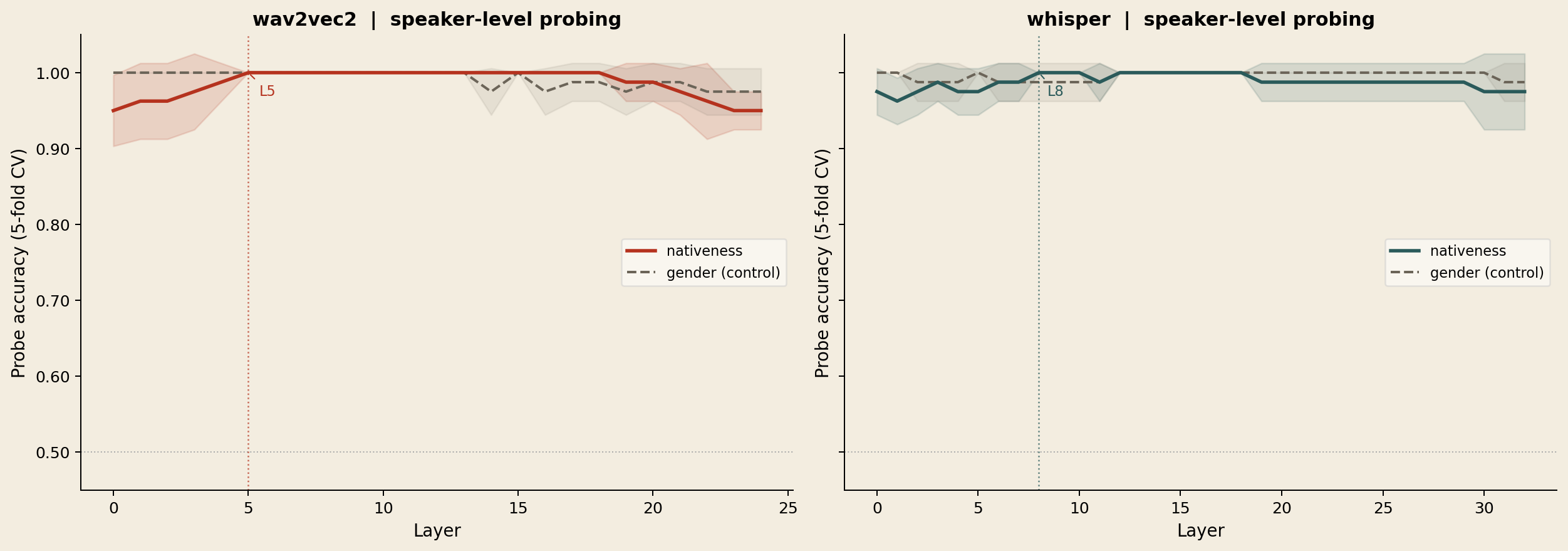
Layer-wise nativeness probe accuracy for wav2vec2 and Whisper
Mechanistic Interpretability · 2026

Inside the Nativeness Axis

Compared how wav2vec2-XLS-R and Whisper Large v3 represent native and non-native Arabic speech. Layer-wise probes identified a perfectly separating direction at intermediate layers; causal ablation weakened nativeness decoding while preserving gender, and phoneme-conditioned attention analysis connected the effect to Arabic emphatics and uvulars.
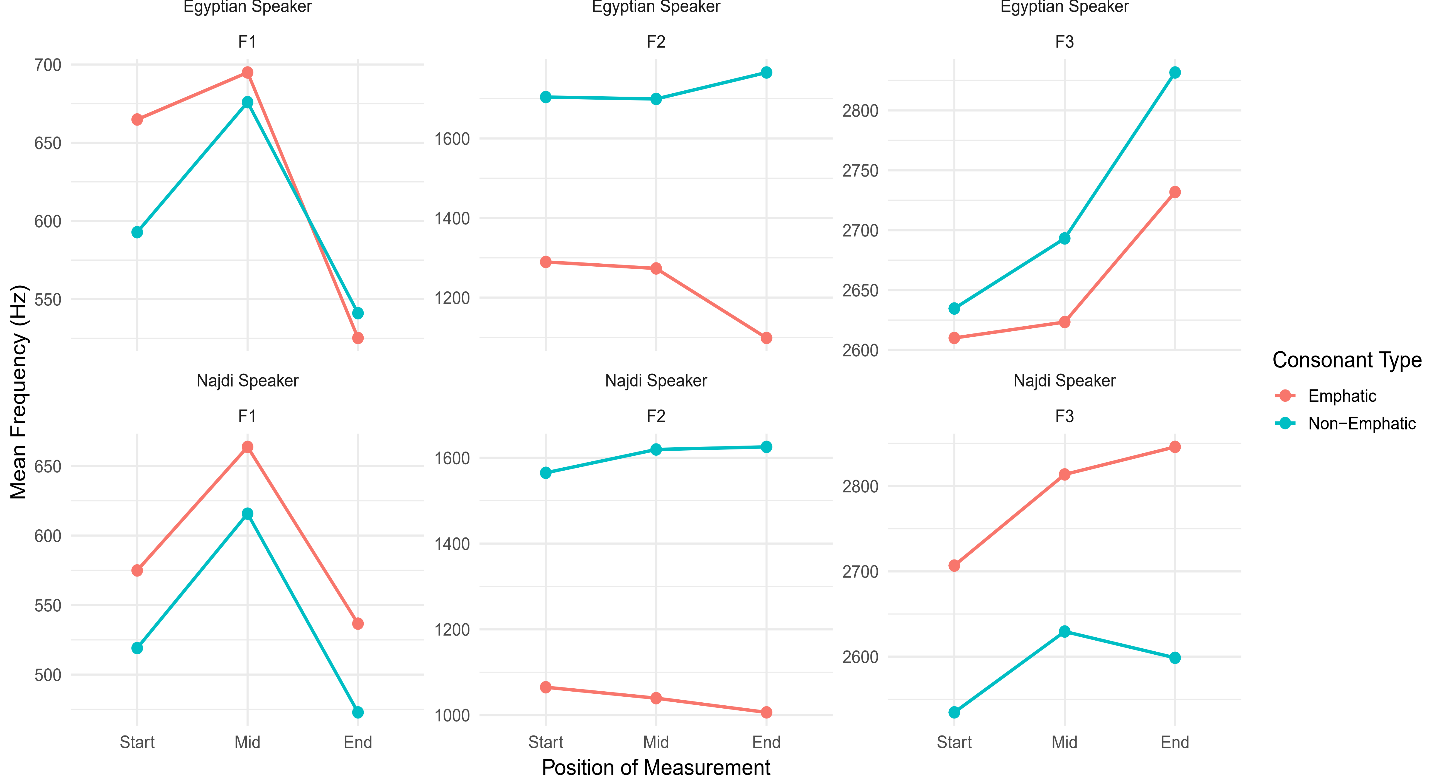
Line plots comparing vowel formants before emphatic and plain consonants for Egyptian and Najdi speakers
Introduction to Phonetics · 2024

Oral Stops, Vowel Formants, and Emphatic Consonants

Used Praat and R to compare voice onset time and vowel formants in American English and Modern Standard Arabic. In this small exploratory sample, emphatic consonants affected vowels on both sides of the consonant: adjacent vowels were generally more open and retracted, reflected in higher F1 and lower F2 values.

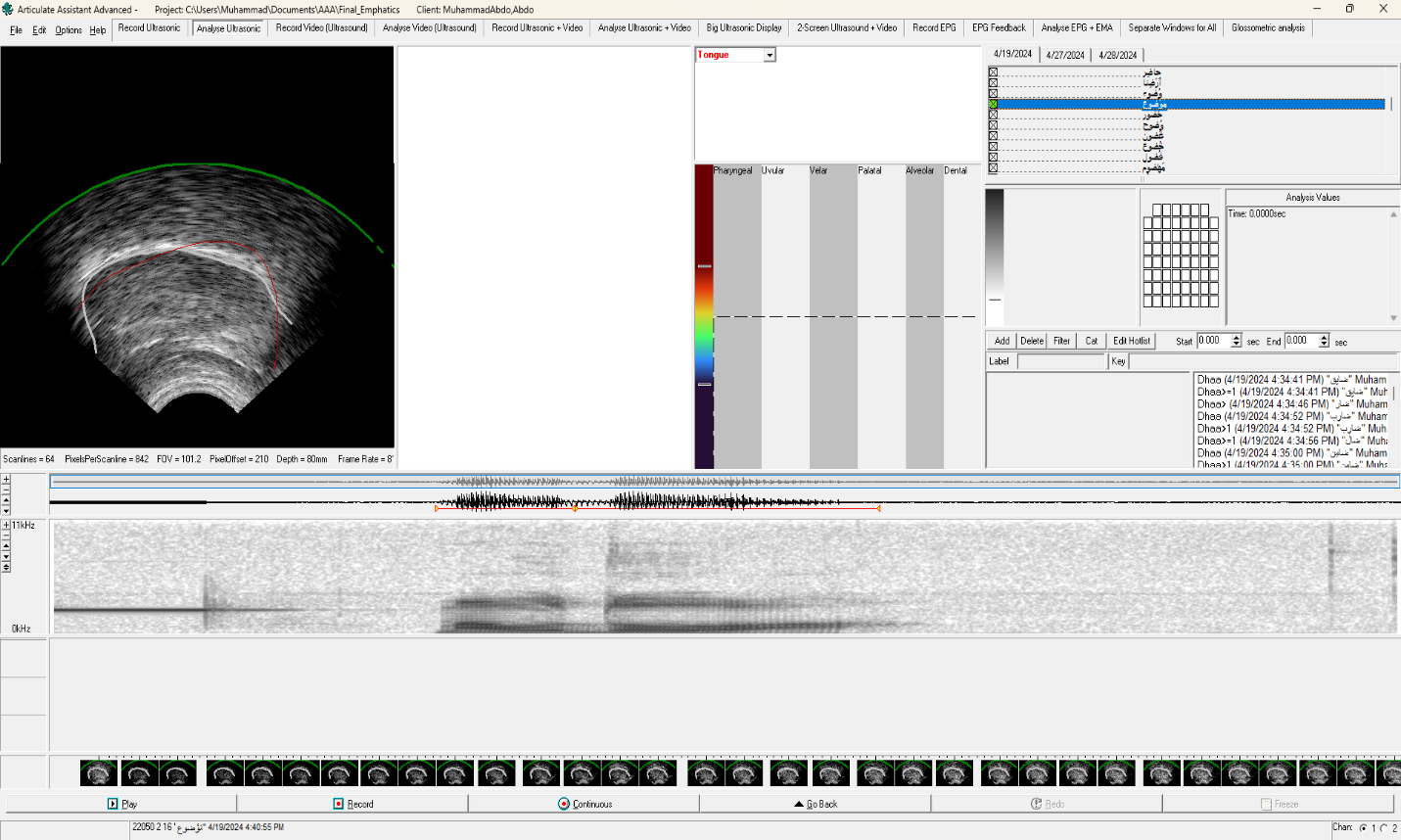
Ultrasound tongue-imaging analysis interface used to study Arabic emphatic consonants
Phonological Analysis · 2024

Spreading of Arabic Emphatic Ḍād

Analyzed 261 Egyptian Arabic words with synchronized ultrasound and acoustic data. The exploratory results indicated that consonant position and vowel length influenced emphasis spread, with clearer rightward effects in medial position and stronger spreading in several long-vowel environments.

Arabic Pragmatics · 2023

Human and LLM Apologies in Egyptian Arabic

Compared apology strategies from six native speakers with ChatGPT responses in two role-play scenarios. Humans more often supplied explanations or contested blame, whereas the model strongly favored accepting responsibility and offering immediate repair; its output also shifted inconsistently between Egyptian Arabic and Modern Standard Arabic.

Research Tools & Resources

Open tools and datasets developed as part of ongoing research.

🔭
Rasid — Arabic Twitter Corpus

A 900M+ word Arabic Twitter corpus organized year-by-year, month-by-month, and week-by-week. Supports word frequency analysis, collocation search, wildcards, and geographic visualization. Includes a Modern Standard Arabic layer from opinion articles.

900M+ words 10 years Twitter
📊
Hoosiers Arabic Ellipsis Corpus (HAEC)

658 annotated sentences of Arabic ellipsis types (gapping, stripping, sluicing) extracted from the ArTenTen corpus using CQL. First comprehensive Arabic ellipsis dataset. Available on GitHub with code for ML benchmarking.

658 sentences Ellipsis MSA GitHub ↗
🌐
ASAL39 Conference Website

Designed and deployed the full conference website for the 39th Annual Symposium on Arabic Linguistics at Indiana University Bloomington. Managed registration, scheduling, and attendee communications through the platform.

Conference Web Dev ASAL39